

Material knowledge
Why Vulcanized Rubber for Water and Pipeline Sealing?
A gasket does not prove its quality at the moment of installation. The real question is how the material behaves after repeated compression, temperature changes, pressure variation, ageing and exposure to the actual medium.
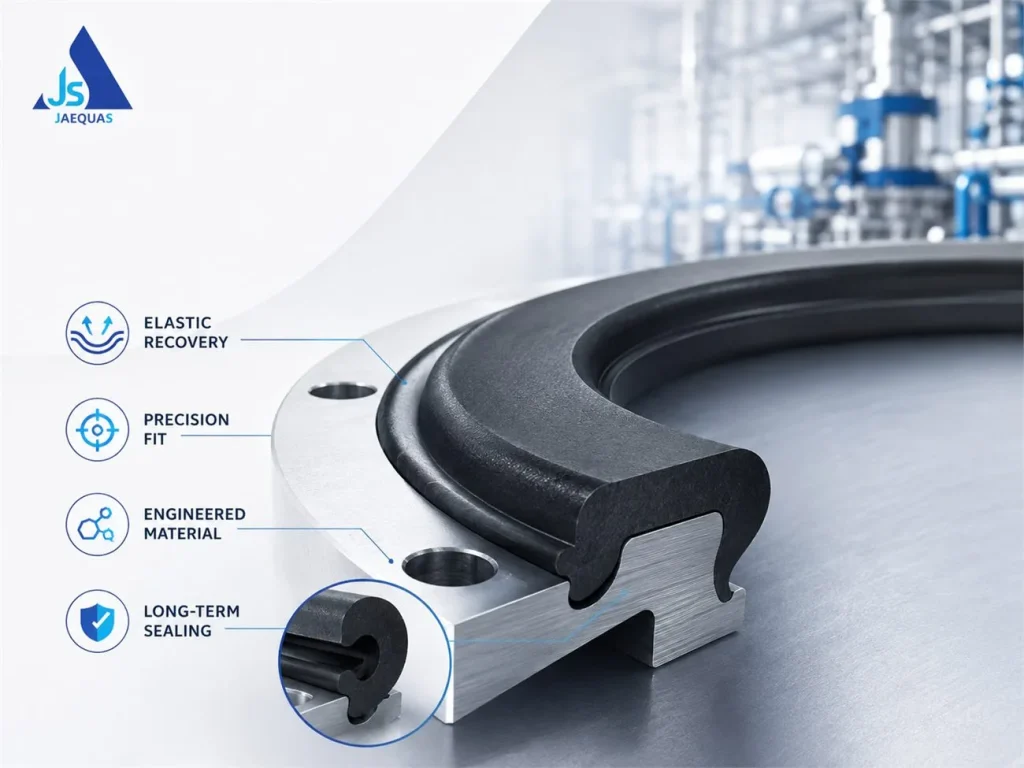
Why vulcanized rubber?
We like 1980s durability
Remember when you had to replace the tap sooner than the gasket?
Planning for the long term with a rubber seal? Then our quick comparison table is worth a look. (General industry data — deviations may occur!)
| Property (installed under compression, as a water seal) | Extruded rubber market average | TPE market average | Vulcanized rubber JAEQUAS |
|---|---|---|---|
| Compression set (After installation, what percentage of the compressed material is lost for good — the rest never springs back.) | 40–55% | 35–50% | 10–14% |
| Tensile strength | 5–8 MPa | 5–15 MPa | 14 MPa |
| Elongation at break | 150–250% | 200–400% | 300% |
| Density | 1.10–1.20 g/cm³ | 0.90–1.10 g/cm³ | 1.23 g/cm³ |
| Continuous temperature resistance — SBR | −28°C / +76°C | max. approx. +50°C | −40°C / +70°C |
| Continuous temperature resistance — EPDM | −30°C / +100°C | max. approx. +130°C (TPV!) | −40°C / +130°C |
| Elasticity after ageing | Deteriorates | Deteriorates | Remains stable |
| Standard compliance | ? | ? | EN 681-1 ✔ |
| Potable-water certification | ? | ? | Hungarian potable-water approval |
| Service life at around 30 °C | 5–10 years | 3–5 years | 10–30 years |
| Service life at around 70 °C | 2–4 years | 1–2 years | 10–30 years |
Rubber is not just rubber
For years people have been asking the same question when they first meet a vulcanized rubber seal: “What is the difference? Rubber is rubber.” That single sentence is the reason a repair only works in the short term — because before long you are back with dripping taps, leaks and gaskets that have slid out of place, again and again.
Not all rubber is the same. And that is not marketing copy — that is physics.
What happens to a gasket after it is pushed in?
When a gasket is clamped — whether in a tap, a hose coupling or a flange — the rubber is put under compression. The question is not whether it seals in the first moment. Of course it seals. The question is what it does after six months, two years, five years, ten years.
Extruded or pressed rubber gaskets — the kind you find in most cheap assortment boxes — do not go through a vulcanization process during manufacture. The molecular structure of the material is loosely connected, without crosslinks. The result: a material that looks and feels like rubber, but behaves closer to a plastic.
Vulcanized rubber, by contrast, goes through heat treatment and a sulphur crosslinking process. The molecules form a tightly connected network — not simply pressed together, but chemically bonded. This is the difference that takes the service life of a seal from 3–5 years to 10–30 years.
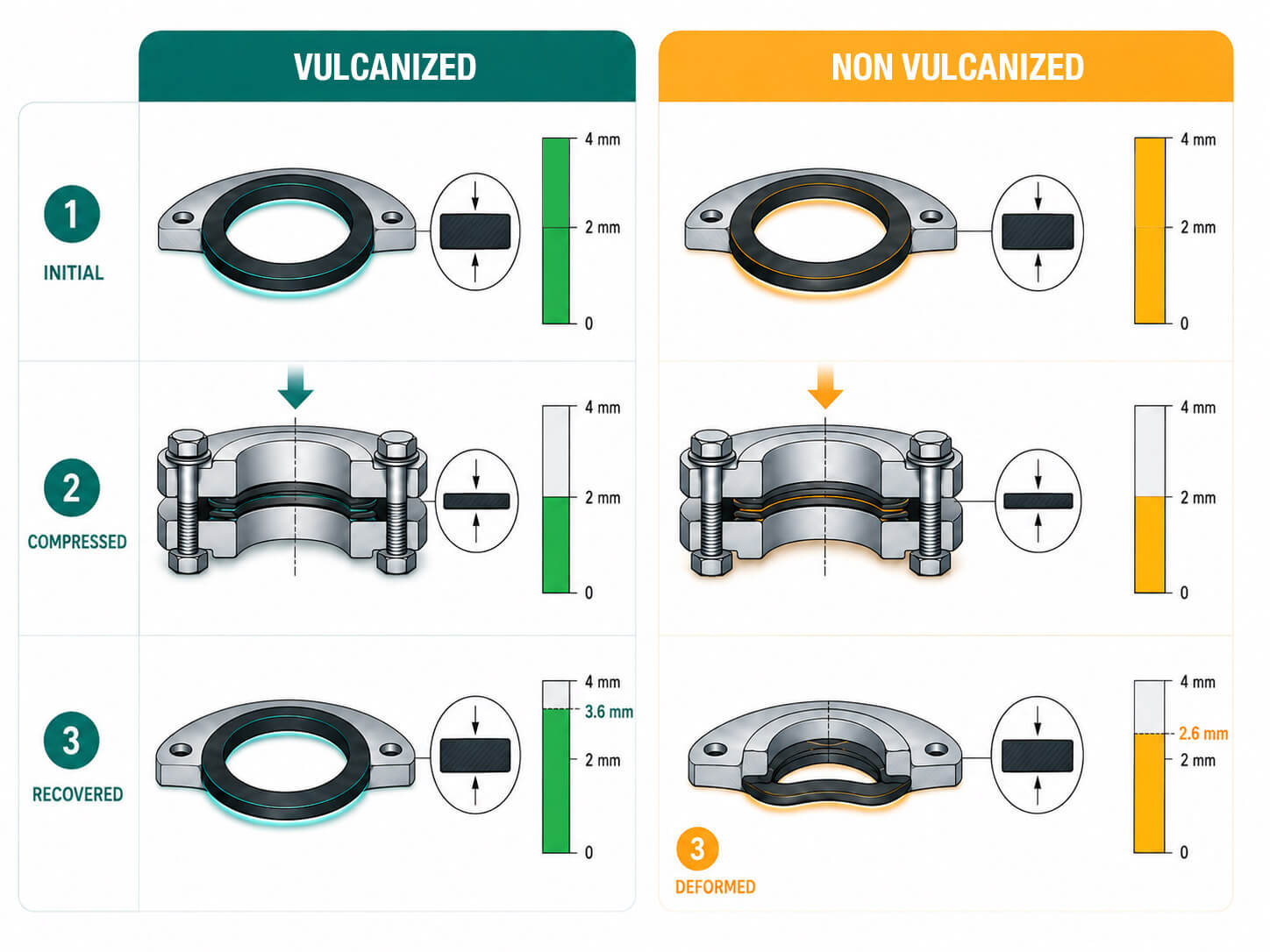
Compression set — the thing nobody tells you about
There is one figure most distributors carefully avoid in the product description: compression set, the permanent deformation. It measures how far the material returns to its original thickness after sustained compression.
A simple example: you compress the gasket to 3 mm. Two years later — after temperature swings, pressure pulses and chemical exposure — the material springs back to only 1.8 mm. The remaining 1.2 mm is lost. That is why the tap starts to drip: it does not spring back into “its place”.
- Extruded market rubber: compression set 40–55% — under sustained load the material flattens to nearly half and does not spring back
- TPE: compression set 35–50% — similarly poor recovery, particularly at higher temperatures
- Vulcanized rubber (JAEQUAS): compression set 10–14% — the material springs back, holds its shape and seals for years
This is not a theoretical difference. This is the difference between a gasket that has to be replaced after two years and one that does not. That is why our seals have been in use for decades.
The alternatives
TPE — the darling of modern marketing, and what lies behind it
In recent years another material has appeared on the sealing market: TPE (thermoplastic elastomer). Easy to produce, cheap to manufacture, and it looks excellent in a product description. “Flexible, durable, versatile.”
The reality is more nuanced.
TPE is a thermoplastic material. That means at high temperatures — in heating systems, hot-water networks, sun-exposed outdoor connections — the material loses its elasticity and deforms. The most widespread styrenic TPE types already begin to give way above 80–95°C — while the operating temperature of a heating system can reach 90°C.
On top of that, TPE contains no real chemical crosslinks — the molecules are held together only by weak physical bonds, which dissolve under heat. The same fundamental problem as extruded rubber, just served in a more modern package.
In heating systems, solar circuits and industrial applications a TPE seal is a risk. Vulcanized EPDM rubber is not.
About asbestos-free sheet-cut gaskets — honestly
Asbestos-free fibre gaskets — Temasil, Klingersil and similar — are excellent materials. They were developed specifically for high-temperature and high-pressure applications: industrial pipework, steam lines, flange connections. Where they are needed, they are unbeatable.
But in household and sanitary applications — where a tap seal, a hose coupling or a radiator connection gasket is needed — the drawbacks of fibre gaskets also show up:
- Stiffer material: it does not conform perfectly to the mating surface, especially on old, worn threads
- Swells with moisture: after a longer period standing in water the material can change
- Not elastic: if the connection loosens, a fibre gasket does not compensate — rubber does
In pipework applications vulcanized rubber is more flexible, adapts better to the mating surface, and keeps sealing even as the thread wears. That is why most plumbers choose rubber for tap seals and for flanges: the rubber takes up the unevenness on the flange face.
What vulcanization changes
During manufacturing, raw rubber compound is formed under heat and pressure into a crosslinked structure. That structure is what determines the final mechanical and chemical properties of the gasket, and it can be engineered for elastic recovery, mechanical strength, temperature resistance and chemical compatibility.
The final performance still depends on the compound, the geometry, the hardness, production control and the application conditions — which is why material selection is always application-specific rather than a catalogue choice.
Why it is useful in utility sealing
- Elastic recovery helps maintain contact pressure after compression cycles
- Compound selection tailors the seal to water, temperature, chemicals or other media
- Custom moulded geometry can combine sealing with reinforcement, filtering or length compensation
- Large and non-standard sizes can be produced when catalogue parts do not fit
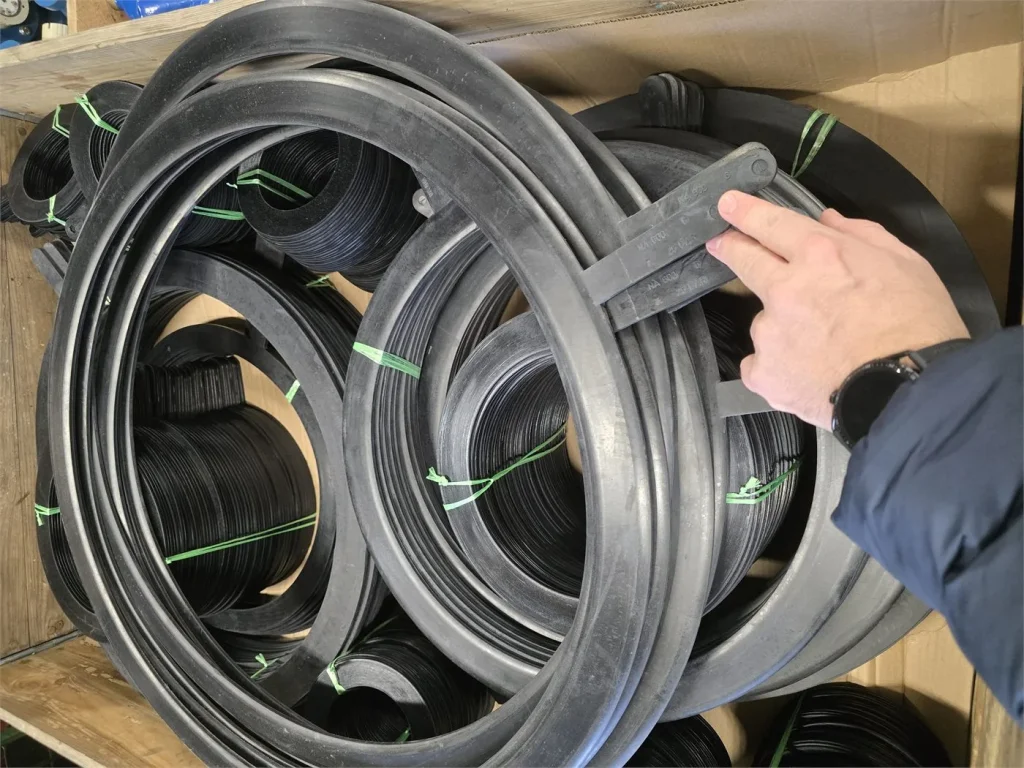
In the ground, nothing is as flat as the drawing
A correctly specified and produced vulcanized gasket adapts to the manufacturing tolerances of pipes, flanges and fittings, while resisting pressure fluctuation, temperature change and the loads caused by ground movement.
That is what separates a gasket that holds for years from one that has to be replaced at the next inspection. It matters most in distribution networks, chambers, water-meter assemblies and industrial connections, where the joint is rarely as perfect as the specification assumes.
Compliance
Potable water and EN 681-1
For potable-water and drainage applications, material compliance must be treated as a procurement requirement, not a marketing label. EN 681-1 specifies material requirements for vulcanized rubber seals used in relevant water and drainage applications. National drinking-water approval requirements may also apply in the destination country.
Selected JAEQUAS compounds hold Hungarian potable-water approval. Before specifying a product for potable water outside Hungary, confirm the national approval required in that market — acceptance is not automatically transferable between European countries.
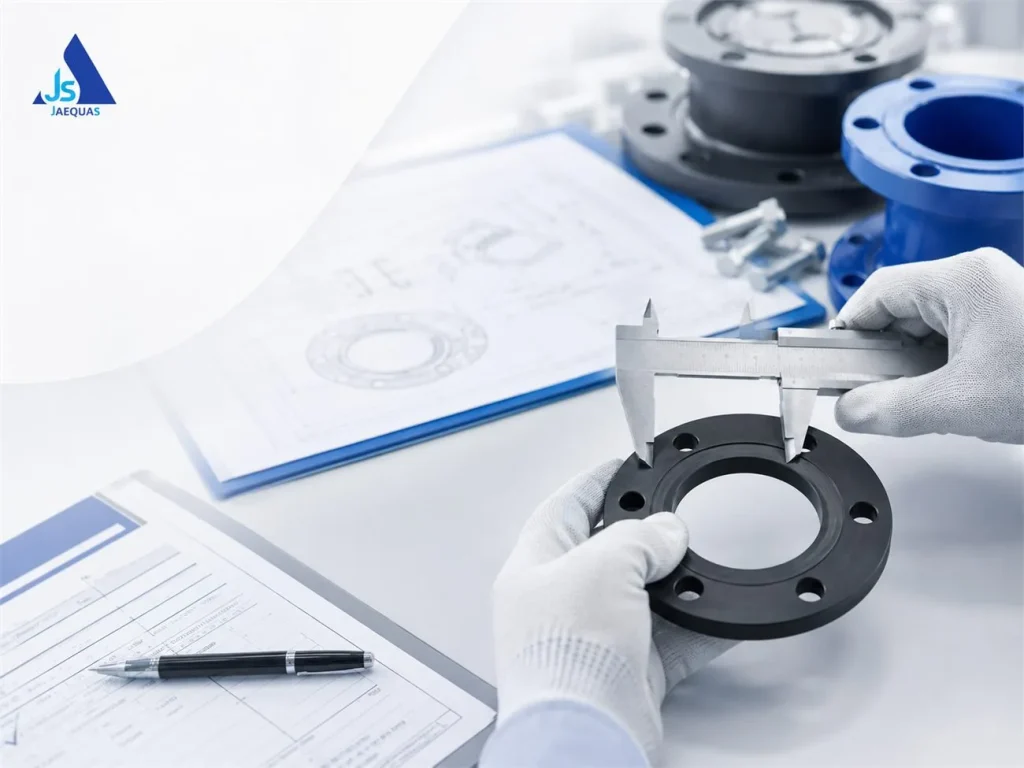
Compression set: a useful parameter, not a standalone verdict
Compression set describes the permanent deformation remaining after an elastomer specimen has been compressed under defined test conditions. Lower values can indicate better elastic recovery in that specific test, but results are only comparable when the material grade, test method, temperature, duration and specimen geometry are equivalent.
The figures in the comparison table above should therefore be read as typical material behaviour rather than as a guaranteed specification for a particular compound. If compression-set behaviour matters for your specification, tell us the application and we will discuss what is realistic for the compound in question.
Vulcanized rubber is not always the only correct answer
High-temperature steam, aggressive chemicals, extreme pressure or a specific flange standard may call for fibre sheet, PTFE, graphite or another sealing technology. The correct material is the one that matches the medium, temperature, pressure, flange condition, movement, installation method and regulatory requirements.
If a different technology suits your application better, we will say so — and in many cases we can still cut the gasket for you.
FAQ
Frequently asked questions
Is vulcanized rubber always better than TPE?
No. TPE is a broad family of materials and some TPV materials include a dynamically vulcanized rubber phase. The correct comparison must be made using the exact material grades and test data relevant to the application.
Can JAEQUAS make a non-standard gasket?
Yes, many geometries can be produced to custom dimensions, particularly where a drawing or physical sample is available.
What information is needed for material selection?
Medium, temperature, pressure, geometry, movement, required approvals and expected service conditions.
Does EN 681-1 replace a national drinking-water approval?
No. EN 681-1 covers material requirements for vulcanized rubber seals in relevant water and drainage applications. National drinking-water acceptance is a separate requirement and is not automatically transferable between European markets.
How should the material comparison table be read?
As indicative material behaviour, not as a specification. Compression-set and service-life figures are only strictly comparable when the material grade, test method, temperature and specimen geometry are identical. Use the table to understand the difference between the material families, then ask us for the data relevant to your own application.
Tell us the medium, temperature and pressure
We will propose a compound and a geometry that match the real service conditions — or point you to a better-suited sealing technology.
 English (UK)
  Magyar
  Deutsch
  Slovenčina
  Čeština
  Română
  Hrvatski
  Polski