

Metal-Reinforced vs Standard Rubber Flange Gaskets
When internal reinforcement genuinely helps at large diameters — and what it cannot fix.
Published 31 August 2026 · Written and technically reviewed by the JAEQUAS technical team
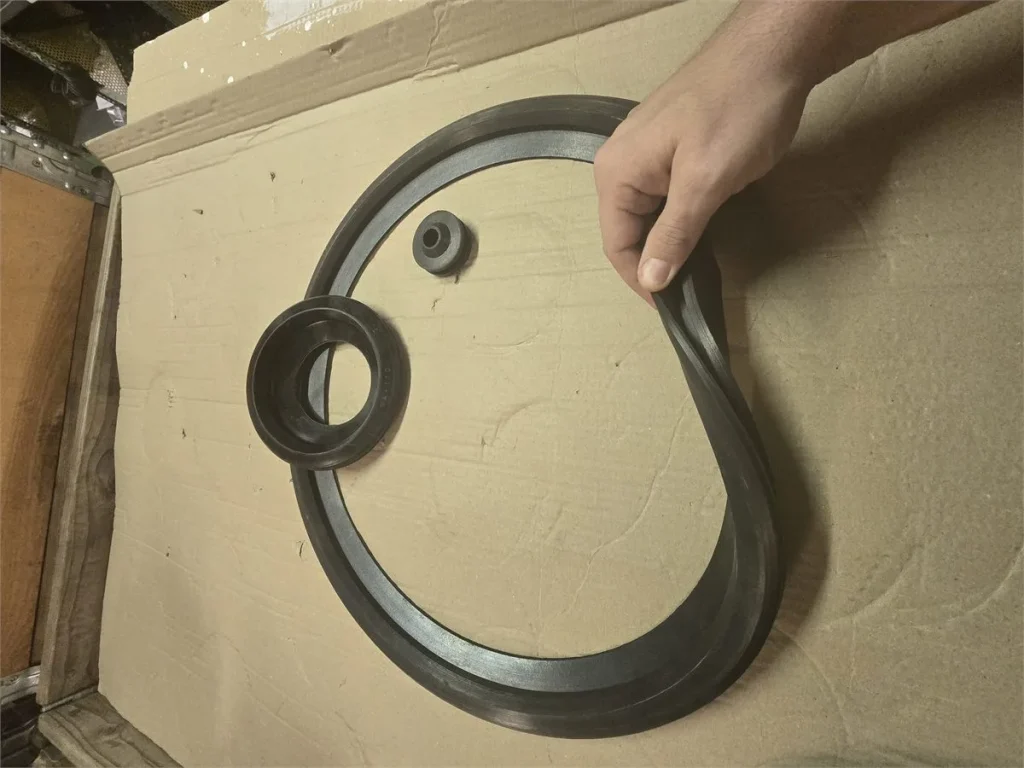
The main difference is handling, not a new sealing principle
Both standard and metal-reinforced versions rely on an elastomeric sealing body. Internal reinforcement is introduced primarily to improve shape stability, especially when the gasket becomes large enough to bend or deform under its own weight.
When a standard gasket is usually sufficient
For smaller and medium diameters, a correctly designed standard vulcanized rubber gasket is normally straightforward to transport, centre and install. Adding reinforcement would create unnecessary complexity if handling is already stable.
When reinforcement becomes useful
At larger diameters, the gasket may sag, fold or become difficult to centre before the bolts are tightened. Internal reinforcement helps the part hold its geometry so installers can position it more easily — which matters most when access around the flange is limited.
What reinforcement does not solve
It does not correct badly aligned flanges, damaged sealing surfaces or incorrect bolt tightening. Those are joint-design and installation issues that must be addressed separately.
Material still matters
The elastomer compound should still be selected for the medium, pressure, temperature and regulatory requirements. Reinforcement affects handling and mechanical stability, but it does not replace correct compound selection. See Why Vulcanized Rubber for how compound choice affects long-term sealing.
Information for quotation
Send the DN, exact flange standard, gasket thickness, medium, pressure, temperature and quantity. For unusual diameters, a drawing of the flange or the existing gasket is strongly recommended.
Send these details with an enquiry
- DN and exact flange standard
- Gasket thickness
- Medium, pressure and temperature
- Installation access and orientation
- Quantity
- Drawing of the flange or existing gasket
Large diameter and limited installation access?
Send the application, dimensions and operating conditions. We will review it and propose the next step.
 English (UK)
  Magyar
  Deutsch
  Slovenčina
  Čeština
  Română
  Hrvatski
  Polski