

How to Select a Flange Gasket for Water Utility Pipelines
A practical selection sequence: application first, then geometry, medium, pressure, compliance and — only at the end — the material name.
Published 31 August 2026 · Written and technically reviewed by the JAEQUAS technical team
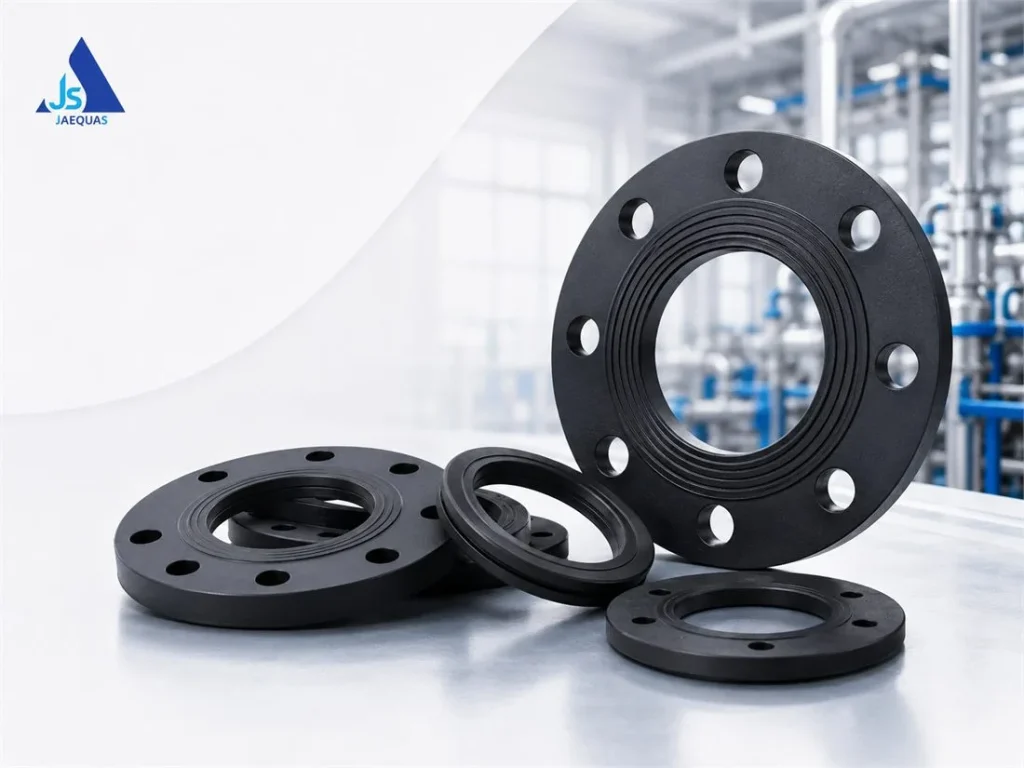
Start with the application, not the material name
The phrase “rubber gasket” is not enough information for a reliable selection. A useful specification begins with the actual service conditions: what medium is being sealed, what temperature range occurs, what pressure the joint sees, whether the pipeline moves or vibrates, and whether the material needs a drinking-water approval.
1. Identify the exact flange geometry
Nominal DN is only the starting point. Confirm the flange standard, bolt-circle geometry, inside diameter, outside diameter and required gasket thickness. For non-standard or old installations, a physical sample or precise measurement can prevent a costly mismatch.
2. Define the medium and temperature
Water, hot water, chemicals, hydrocarbons and process fluids can require very different elastomer compounds. Temperature is equally important because mechanical properties and compression behaviour change as the material is heated or cooled.
3. Consider pressure and joint condition
The gasket works as part of a complete bolted joint. Flange stiffness, surface condition, alignment, bolt load and operating pressure all affect the seal. A thicker or softer gasket is not automatically safer.
4. Check regulatory requirements
If the gasket is used with drinking water, the required approval must be confirmed for the destination country. EN 681-1 may be relevant for vulcanized-rubber seals in water and drainage applications, but national drinking-water requirements can also apply. See our Quality & Compliance page for what documentation we can supply.
5. Decide whether the geometry needs a special function
A standard flat gasket is not always the best answer. Large diameters may benefit from internal reinforcement. Sensitive equipment may benefit from a strainer gasket. Retrofit work may require a spacer or length-compensating element.
What to send with an enquiry
For a faster technical review, send DN and exact dimensions, flange standard, pressure, medium, temperature, required approval, quantity and destination country. Photos or a drawing are especially helpful for older or non-standard installations.
Send these details with an enquiry
- DN and exact flange dimensions
- Flange standard and drilling pattern
- Operating pressure and known peaks
- Medium, chemical exposure and temperature
- Required approval for the destination country
- Quantity and delivery expectation
Not sure which gasket family fits your flange?
Send the application, dimensions and operating conditions. We will review it and propose the next step.
 English (UK)
  Magyar
  Deutsch
  Slovenčina
  Čeština
  Română
  Hrvatski
  Polski